
What the count-in tells the players
A count-in gives musicians a short rhythmic lead-in before they begin playing. It establishes the tempo and tells them where the entrance falls. A drummer can count aloud or use sticks; recorded playback can provide spoken numbers or clicks.
Agree on what the last count means. If one player starts after the last number while another starts on it, the band will split even when everyone hears the same pulse. Decide which beat begins the music before running the song.
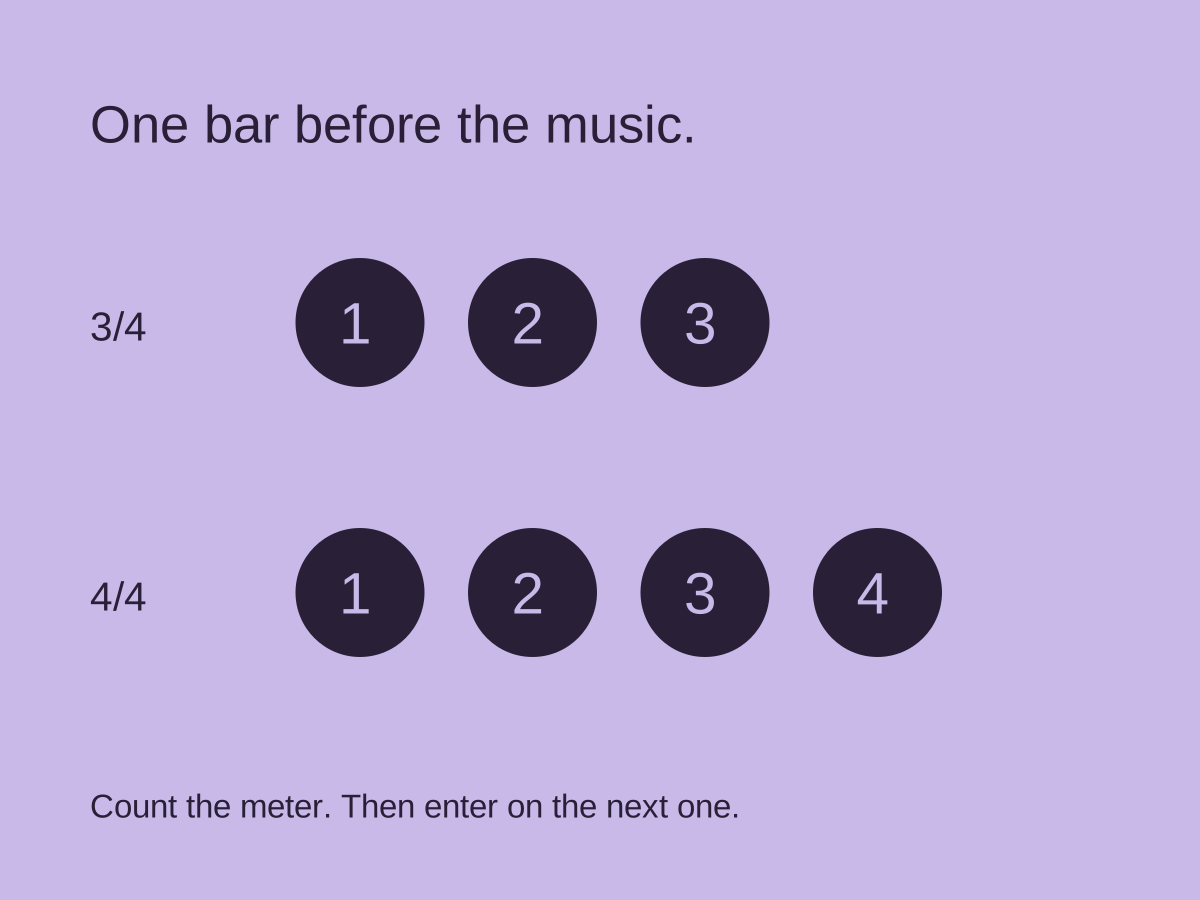
One bar in 4/4
For a one-bar lead-in in 4/4, count “one, two, three, four,” then begin the music on the following “one.” The four spoken numbers occupy a complete bar before the first full bar of music.
At 120 quarter-note BPM, the count lasts two seconds. At 60 quarter-note BPM, the same bar lasts four seconds. The number of beats is unchanged; their spacing changes with the tempo.
Try clapping the four counts, then playing a chord on the next downbeat. Repeat without speaking. This checks whether everyone understands the entrance before adding a difficult instrumental part.
One bar in 3/4
In 3/4, a one-bar quarter-note lead-in contains three beats: “one, two, three,” followed by the entrance on the next “one.” At 120 quarter-note BPM, that bar lasts 1.5 seconds.
A section announcement can take the place of the first number: “Chorus, two, three,” then enter. That is the pattern in our spoken cue guide. It still occupies three beats; the section name gives the first beat extra information.
Both examples use quarter-note BPM. Check the meter and beat unit of your own passage before choosing its count-in.
Choose enough preparation time
One bar may be sufficient when the instrument is ready and the entrance is familiar. Two bars can help when someone needs time to settle into the pulse after starting playback. Agree how players distinguish the first lead-in bar from the final one.
Recording software also treats count-in length as a setting. For example, Ableton’s recording documentation describes choosing a count-in before recording. Choose the length that gives your band enough time to prepare for the entrance.
If a player needs an earlier reminder to change instruments, give that reminder before the final rhythmic count. Avoid packing a long instruction across the beats everyone is using to prepare.
Account for pickup notes
Some parts begin before the first full downbeat. A singer might enter on beat four of the lead-in bar while the rest of the band starts on the next one. Continuing to wait until after “four” would make that singer late.
Mark the earliest musical entrance and count toward it. Our pickup example shows a vocal entering on beat four, with the backing instruments arriving one beat later.
Test the lead-in without watching a screen, then play through the first phrase. In Cuebie, prepare section markers and spoken count-ins using the setup guide. Check that the cue gives notice before the earliest entrance.