
Give the next entrance a name
A click tells you where the beat is. A spoken cue tells you what is coming. If a band keeps counting through a quiet passage but still misses the chorus, naming that entrance can be more useful than making the click louder.
Start with the transitions that cause trouble in rehearsal. You do not need a voice announcing every section. A useful cue arrives early enough to prepare for the next part and uses a name everyone recognizes.
Agree on section names first
Choose names your band already uses: verse, chorus, bridge or outro. If one player calls a section the bridge and another calls it the middle eight, settle that before preparing the track. Everyone should recognize the name as soon as they hear it.
Mark the start of the new section, then plan the spoken lead-in before that point. The marker belongs to the entrance; the announcement belongs ahead of it. Putting both at the same moment leaves little preparation time.
Listen for pickups as well. A vocal or guitar phrase may begin before the first downbeat of the section. The musician needs notice before their own entrance, which can be earlier than the section marker.
A 3/4 example: “Chorus, two, three”
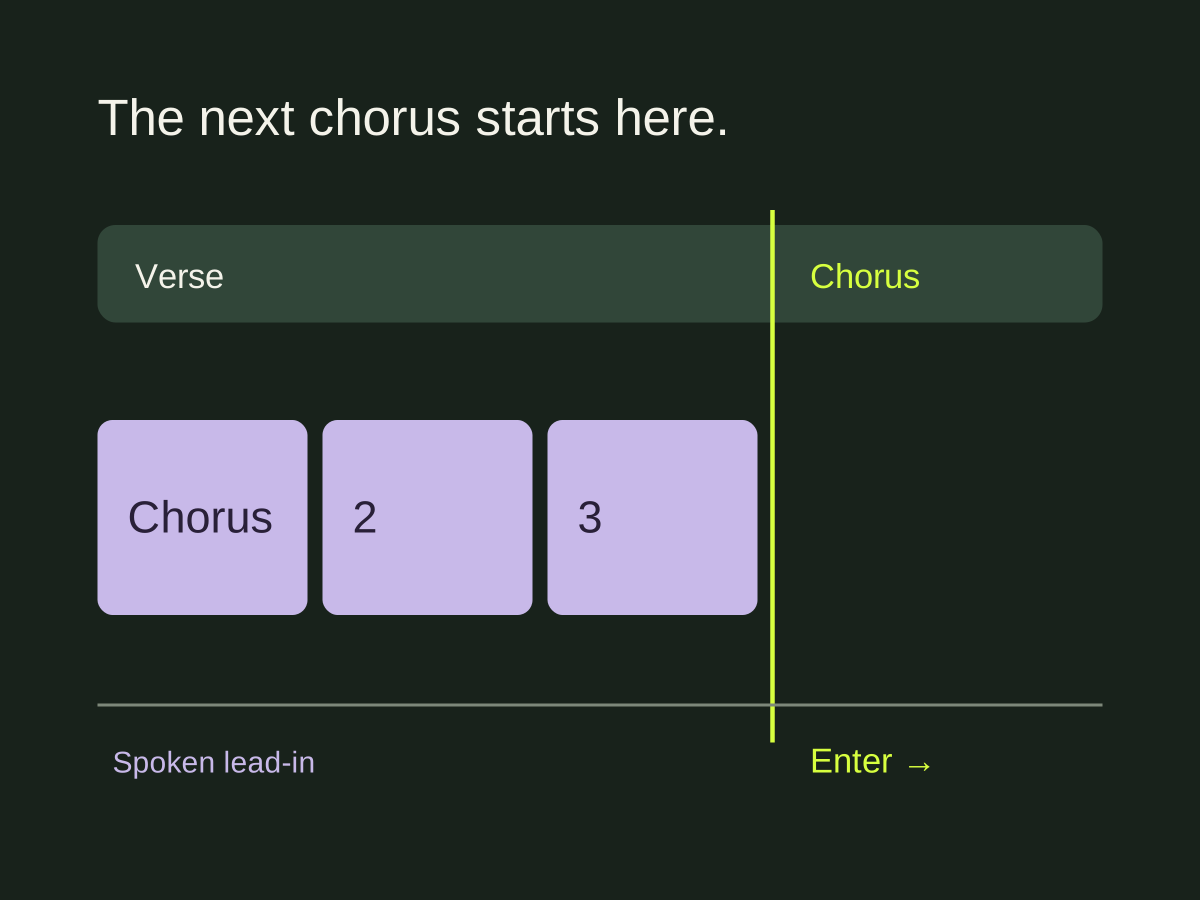
In a one-bar lead-in at 3/4, you can say “Chorus” on the first beat, “two” on the second and “three” on the third. The chorus then begins on the next downbeat. The section name takes the place of “one.”
At 120 quarter-note BPM, each beat lasts half a second, so that three-beat bar lasts 1.5 seconds. Use your recording’s own meter and tempo when placing the cue.
You can hear Cuebie’s chorus example to understand how a section name and count fit together.
A 4/4 example and a longer lead-in
The same pattern in 4/4 becomes “Chorus, two, three, four,” followed by the entrance on the next downbeat. At 120 quarter-note BPM, one 4/4 bar lasts two seconds.
That may be enough for a familiar entrance. A musician switching instruments or entering after a long rest might need an earlier warning. Agree on that warning during rehearsal, then check that the chosen cue timing is supported by the tool you use.
A longer announcement is not always clearer. If a phrase runs across the beats the band is trying to count, shorten it or place it earlier. Leave the final lead-in easy to follow.
Test the cue while playing
A cue that sounds clear while you listen alone can disappear behind drums, guitars or a busy headphone mix. Test it at a comfortable monitoring level with the parts you will actually play. Check whether each musician can identify the words without losing the pulse.
- Start playback before the lead-in so you hear the cue approaching.
- Play through the entrance without watching the screen.
- Ask whether the announcement gave enough notice.
- Repeat from an earlier passage to check that the cue still makes sense in context.
If the band hears the instruction but enters at different times, agree exactly which beat starts the section. If the words are clear but arrive too late, change placement. Raising the volume will not fix either problem.
Prepare the rehearsal track
In Cuebie, add your recording, set the tempo and first beat, mark sections, and choose spoken cues and count-ins. Balance the song, click and cue levels for rehearsal. The getting-started guide covers the app steps.
For a live playback setup, you can export WAV tracks and arrange the monitoring separately. Keep spoken instructions out of the audience feed unless they are intentionally part of the show. Read click tracks vs backing tracks before deciding what each output should carry.
If the cue lands correctly early in the song but misses later entrances, check tempo and alignment first. Section markers cannot compensate for a click that drifts away from the recording.
Part of our count-ins guide.