
Choose a passage you can listen to
Start with a short passage whose notes you already know. Set a tempo where you can play it comfortably and still listen to the click. If most of your attention goes into finding notes, simplify the part or reduce the tempo.
Decide what one click represents. For this routine, use one click per quarter note in 4/4. Keep that setting while checking entrances and endings so you do not change the exercise halfway through.
First pass: enter after one bar
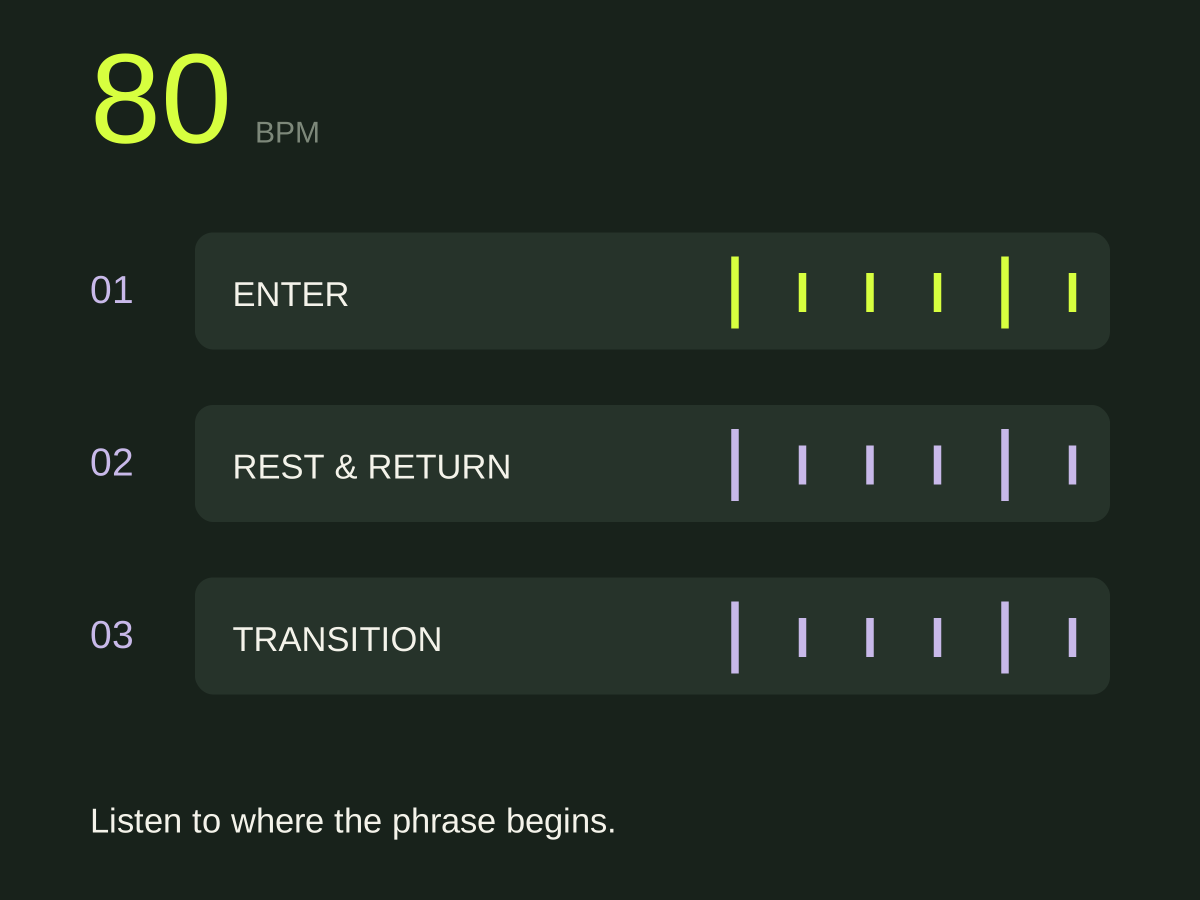
Set the metronome to 80 quarter-note BPM. Listen for a bar, count a second bar aloud, then play a four-bar phrase. Stop at the agreed ending and let the click continue.
At this tempo, each beat lasts 0.75 seconds and each 4/4 bar lasts three seconds. Four playing bars take 12 seconds. Use these timings for this exercise; choose a comfortable tempo when practicing your own song.
Repeat three times. Note whether your first attack lands with the click, whether you speed up during a difficult figure and whether the last note ends where you intended. Work on the repeated problem before making the exercise faster.
Second pass: keep counting during a rest
Play two bars, rest for two complete bars while the click continues, then play two more. Count through the rest. Keep listening after the last note so you can hear whether the return starts where you expected.
Leave the metronome audible and keep counting while your instrument is silent.
For instrument-specific examples, try the drummer’s rest-and-return exercise or the guitar rhythm exercise.
Third pass: approach the transition
Take a section change from a song your band plays. Begin several bars before it, play through the change and continue for two bars afterward. Starting directly on the new section will not test how you get there.
If the entrance is wrong, separate the causes. You may have lost the number of bars, misunderstood the pickup or struggled to play the new part at that tempo. A clear count-in helps with preparation; it cannot settle a disagreement about the form.
Raise the tempo only after you can repeat the passage with the intended placement. Small manual adjustments are enough. Record the tempo you reached so your next practice session has a useful starting point.
Bring a specific note to rehearsal
Write one observation that another player can act on: “I lose the return after two bars of rest” is more useful than “timing needs work.” Ask the band to run that transition before the full song.
If you are playing against an existing recording, check that its tempo stays aligned with your click. A fixed metronome will not follow the fluctuations of a live performance. See why a click can drift before assuming the problem is your playing.
Cuebie can provide a metronome for practice and a prepared click with spoken cues for your song. The setup guide explains both workflows. You can run this routine manually with a steady click and change the tempo between attempts.